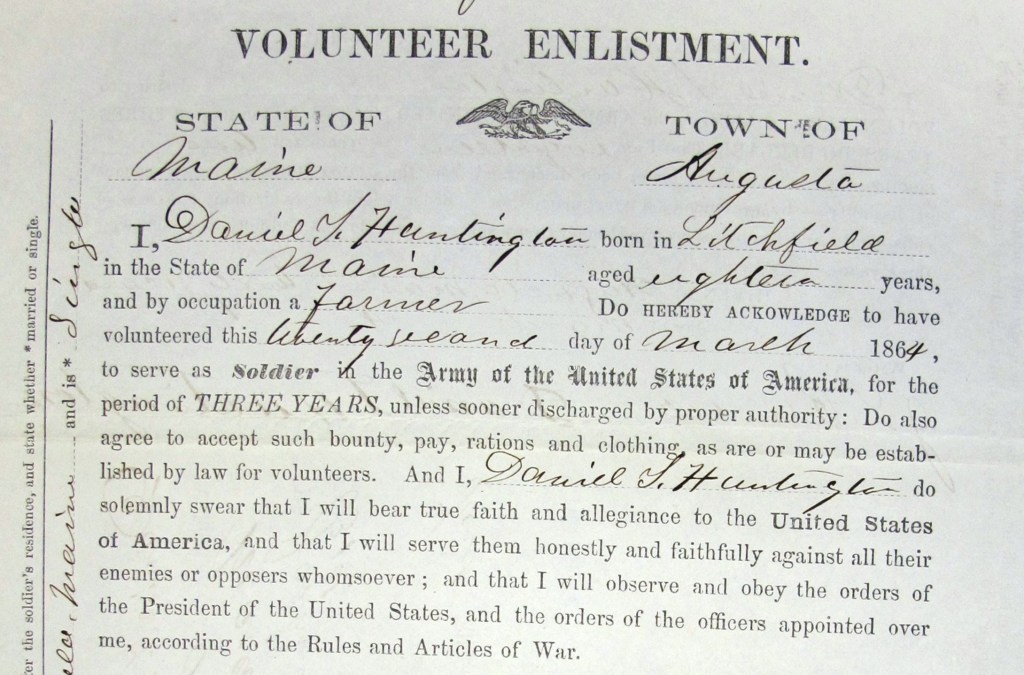
Daniel True Huntington enlisted in the army on March 22, 1864. He joined company I of the newly formed 31st Maine Volunteer Infantry regiment.
Huntington’s enlistment papers describe him as having a fair complexion, with dark eyes and brown hair. He stood five feet, five inches tall. One of 14 children, Huntington was a farmer from the town of Litchfield, a small community about 15 miles southwest of the state capital in Augusta. Joshua L. Randall, the recruiting officer for the regiment, signed the paper testifying that Huntington “was entirely sober when enlisted” and “of lawful age.” Randall was either fooled or was turning a blind eye about the age, for Huntington said he was 18 when he signed, he was only 16 years old.
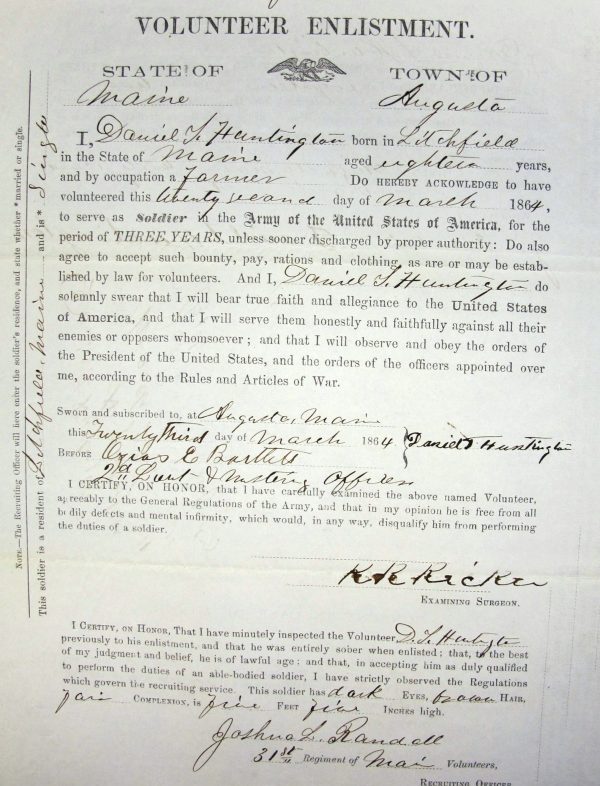
Was he joining for the money? He did receive a $300 bounty. Or was it out of patriotism? Was he snatching at a way to escape from Litchfield? Was he seeking adventure? Such things motivated soldiers to sign up to fight for the Union, but we don’t know what prompted Huntington to leave the farm and join the army. If he wrote any letters or journals about his experiences, they disappeared long ago. But in his enlistment papers he signed on the line that said he bore “true allegiance to the United States of America,” and he swore to “serve them honestly and faithfully against all the enemies or opposers whomsoever” and to “observe and obey the orders of the President of the United States, and the orders of the officers appointed over me, according to the Rules and Articles of War.”
Interesting word, “them.” As others have pointed out, before the American Civil War the states of the union were usually addressed as individuals—“the United States are.” Thanks to the crucible of war, the union would emerge fused together as a single unit, with the “are” changed to “is.”
When Huntington signed his papers, the war between the North and South had been raging for nearly three years. No one knew it at the time, but there was another long year of fighting ahead. The first three years had been bad enough. The final year, especially in the eastern theater, where the Union Army of the Potomac under George G. Meade was facing off against Robert E. Lee’s Army of Northern Virginia, would be even worse.
About a year after Huntington joined the army, the president he swore to obey was sworn in for his second term. In his inaugural address, President Abraham Lincoln noted the role that slavery had played in the war. “These slaves constituted a peculiar and powerful interest,” he told the crowd arrayed before him outside the U.S. Capitol. “All knew that this interest was somehow the cause of the war. To strengthen, perpetuate, and extend this interest was the object for which the insurgents would rend the Union even by war, while the Government claimed no right to do more than to restrict the territorial enlargement of it. Neither party expected for the war the magnitude or the duration which it has already attained.” The war’s severity had, indeed, come as a surprise to people who had expected a quick and relatively bloodless conflict after war broke out following the Southern bombardment of Fort Sumter in April 1861. The first battle of Bull Run, fought south of Washington near Manassas in July 1861, hinted at the ferocity that would follow. Since then, Union and Confederate armies had sparked death and destruction in encounters across the country, and regiments added the names of battle after battle to the flags they proudly carried into combat. Robert E. Lee, newly in command of his Army of Northern Virginia, pushed Union general George B. McClellan away from the Confederate capital of Richmond during the Peninsula Campaign in late June and July 1862. Lee followed that with the defeat of Maj. Gen. John Pope’s cobbled-together Army of Virginia at the second battle of Bull Run in August. Then came the September slaughter at Antietam, the December massacre at Fredericksburg and the Union humiliation at Chancellorsville in May 1863. In July the Army of the Potomac, now commanded by Maj. Gen. George Gordon Meade, defeated Lee’s army at Gettysburg.
Following Gettysburg, the Army of the Potomac pursued Robert E. Lee’s Army of Northern Virginia to the Potomac River at Williamsport, Maryland. Meade’s army was finally ready to move forward and attack Lee’s lines on July 14, only to discover that the Rebel army had escaped across the river during the night. Meade followed his adversary into Virginia, pushing Lee back to the other side of the Rappahannock and then across the Rapidan. There the two armies waited, watching each other warily and looking for an opportunity to attack.
Back in Maine, Daniel True Huntington no doubt followed news of the war and waited to enlist. He would turn 16 on September 25,1863.
In April 1861 President Lincoln had called for 75,000 men to serve in the army for 90 days. That number had proven woefully inadequate. By war’s end more than 2.6 million soldiers, about 35 times more than Lincoln’s initial request, would serve in the Union armies and navy. For the first years of the war voluntary enlistments had provided enough soldiers for the armies, but that was no longer an adequate source of manpower, and the North was showing increasing signs of war weariness. The Union passed its first conscription act—the draft—in March 1863—but when authorities in New York made the initial call for draftees in July, the city erupted in the so-called draft riots. Mobs lynched several African Americans and burned the Colored Orphan Asylum. The Army of the Potomac had to rush units fresh from the battle of Gettysburg north to help civil authorities quell the disturbances.
Discontent was making itself felt even in the normally rock-ribbed state of Maine. After passage of the conscription act, a resident of Buckfield, near Lewiston, wrote to the state adjutant general, John Hodsdon. “I don’t know that you are aware of the state of feeling in this vicinity in regard to drafting,” the anonymous correspondent wrote, “but I know that the people have borne the tyranny as long as they will: the strings are ready to snap.” Also in July, residents of the western Maine town of Kingfield ran some draft officials out of town. The state responded by sending militia, bolstered by regular army soldiers, to end the disturbances. Despite rumors of the “blood-thirsty and desperate character of the rioters and the people at Kingfield,” the small force met with no resistance. In fact, the people of Kingfield treated the soldiers to a picnic and the “riot” ended peacefully.
Lincoln hoped that things would improve in 1864. “Fondly do we hope, fervently do we pray, that this mighty scourge of war may speedily pass away,” Lincoln said in his second inaugural. “Yet, if God wills that it continue until all the wealth piled by the bondsman’s two hundred and fifty years of unrequited toil shall be sunk, and until every drop of blood drawn with the lash shall be paid by another drawn with the sword, as was said three thousand years ago, so still it must be said ‘the judgments of the Lord are true and righteous altogether.’”
Even after the Union victory at Gettysburg, the judgements of the Lord still seemed in question. A lot of fighting and scores upon scores of dead and wounded soldiers still lay ahead. Private Daniel True Huntington of the 31st Maine—my great-grandfather—would find himself in the thick of the fighting.
But first the Union forces needed to get through the rest of 1863.
This is an excerpt from Maine Roads to Appomattox, which Globe-Pequot will publish in May 2027. Stay tuned for ordering information!
In the meantime, you can purchase Maine Roads to Gettysburg at Amazon, Barnes and Noble or the bookstore/website of your choice.


Leave a Reply