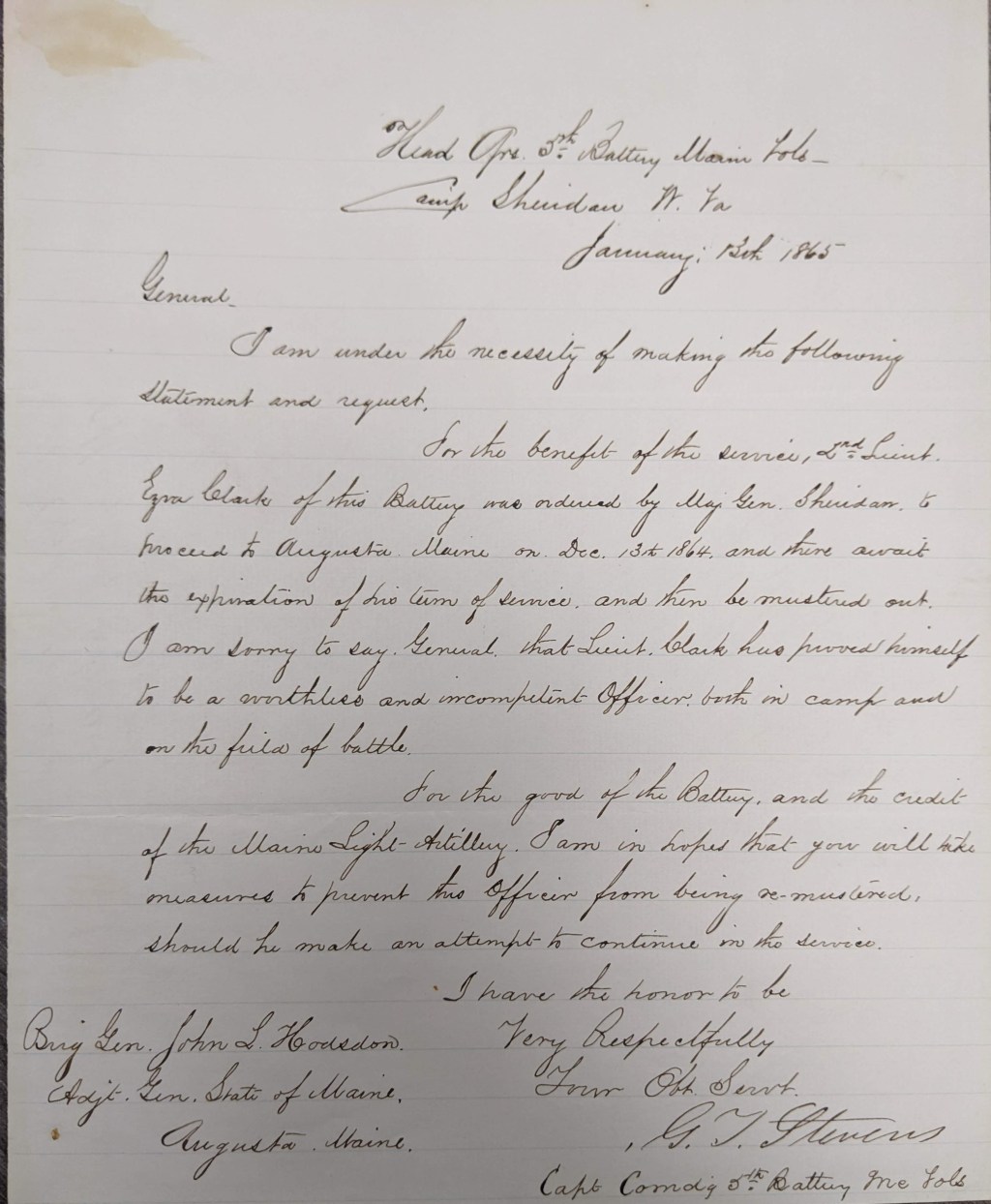
In January 1865, Capt. Greenlief Stevens, commander of the 5th Maine Light Artillery battery, was determined to keep 2nd Lt. Ezra Clark out of the army. On the 13th he sat down to write a letter to Maine’s adjutant general, John Hodsdon. “General,” he wrote, “I am under the necessity of making the following statement and request.
“For the benefit of the Service, 2nd Lieut. Ezra Clark of this battery was ordered by Maj Gen Sheridan proceed to Augusta Maine on Dec. 31st 1864, and there await the expiration of his term of service and then to be mustered out. I am sorry to say, General, that Lieut. Clark has proved himself to be a worthless and incompetent officer, both in camp and on the field of battle.
“For the good of the Battery, and the credit of the Maine Light Artillery, I am in hopes that you will take measures to prevent this officer from being re-mustered, should he make an attempt to continue in the service.”
Charles O. Hunt, who also served with the battery, had no use for Clark either. In the journals he put together after the war, Hunt pasted a newspaper clipping about Clark’s death in 1868 in Titusville, Pennsylvania. Hunt said he understood that Clark had served in the Mexican War but doubted he saw any action in the Civil War, although he did receive a pension for his chronic diarrhea. Hunt believed Clark was a coward. “I do not think he was ever in a fight in his three year service, unless he was surprised at Cedar Creek, and could not get out of it. Either got dedicated to take charge of some trains, or to go away or on recruiting service, or, if he was with the battery then it began to look like a fight, his disability would break out and he would be unfit for duty. He was a steady drinker of whiskey. He was ignorant and quarrelsome. He knew next to nothing about artillery drill. The enlisted men had no respect for him, and did not fail to show their contempt for him, which he did not dare to resent.”
Hunt said Clark had “red hair and a shaggy red beard, which generally looked untidy. His eye lids were red and bleary.” He added, “He was so disagreeable in the officer’s mess that, much of the time, he was either compelled to mess by himself or with some of the Lieuts., “Hunt continued. “Both [Edward] Whittier and I were promoted over him. If he had had any self respect he would have resigned, which all hoped he would do.”
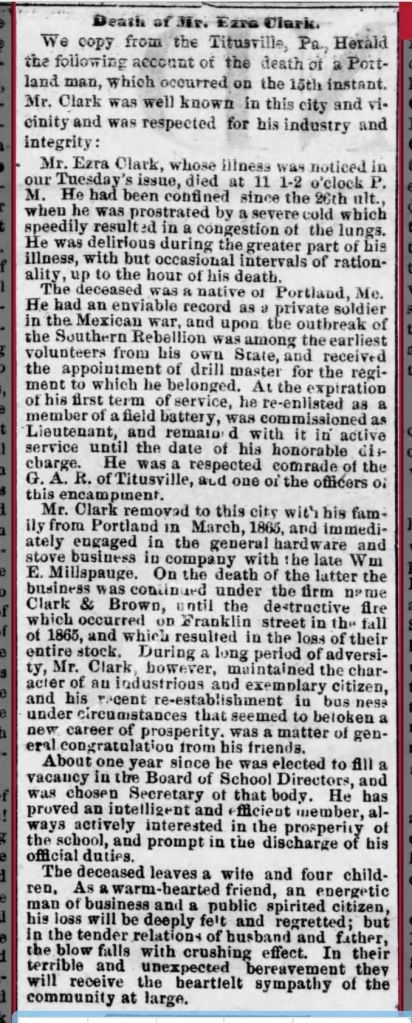
When Clark died, he had a wife and four children. He had moved to Titusville to run a hardware and stove business, which burned to the ground not long afterwards. “Mr. Clark, however, maintained the character of an industrious and exemplary citizen, and his recent re-establishment in business under circumstances that seemed to betoken a new career of prosperity, was a matter of general congratulations from his friends,” read the obituary notice.
Apparently, Clark did all right for himself as a civilian–but not everyone was cut out to be a soldier.
Stevens’s letter is in 5th Maine Battery’s records in the Civil War Regimental Correspondence at the Maine State Archives in Augusta. Hunt’s journals are in the George J. Mitchell Dept. of Special Collections & Archives, Bowdoin College, Brunswick, Maine.


Leave a comment